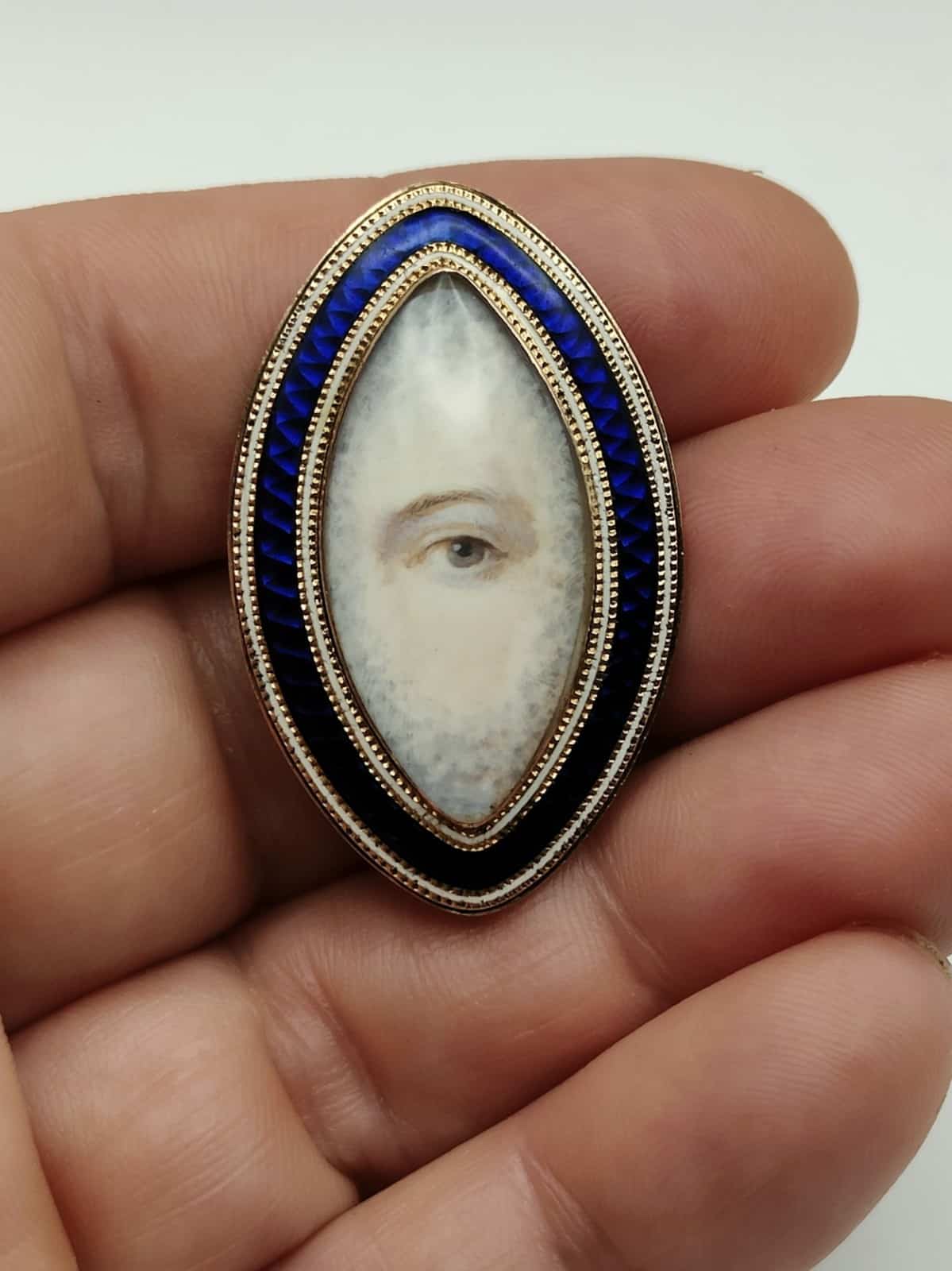
Lovers Eye – Catharine Brodhurst
Original price was: £7,586.00.£5,500.00Current price is: £5,500.00.
Availability: 1 in stock
DISPATCHED FREE WITHIN THE UK VIA COURIER. OVERSEAS DELIVERY VIA DHL AND FULLY INSURED.
OVERSEAS BUYERS: PLEASE FAMILIARISE YOURSELF WITH ALL LOCAL IMPORT TARIFFS/TAXES BEFORE PURCHASE, AS THESE ARE THE SOLE RESPONSIBILITY OF THE BUYER. THANK YOU.
DIMENSIONS:
Brooch Length: 38mmx Width:26mm
Portrait Length: 30mmx Width:15mm
WEIGHT: 6.6g
GOVT. EXEMPTION CERTIFICATE REF# DW8UQ5NB
Here we have for sale a rare and exquisite, historically significant George III period 18 carat gold (unmarked as is typical of the period, but tested) and guilloche enamel, navette shaped eye miniature. The miniature portrait is extremely finely painted in watercolour on wafer, and bezel mounted beneath a domed rock crystal cover.
The portrait depicts a womens brown left eye and brow; as is characteristic of the genre, no other facial features are present, however the eye is painted around with the blue/grey/whispy white suggestion of a clouded sky, indicative of mourning.
This jewel is an exceptionally scarce example of an already rare jewellery type, in that it is precisely dated; however much rarer still, it also features a full inscription to the back. A significant factor in the popularity of eye miniatures was their secret anonymity, so to find one thus inscribed, and in sufficient detail to not only identify the person depicted, but the grieving ‘lover’ who commissioned and wore it, is extraordinarily rare indeed.
According to online searches, Catherine/Catharine Brodhurst/Broadhurst (spellings were not formalised until the 19th century) was born in Mansfield Notts on 24th May 1750-1752 (sources differ). She married Robert Wigram MP, 1st Baronet of Walthamstow (1744-1830) of Walthamstow House, Essex, on 19th December 1772, when she was aged around 20. They had 5 children together, before she died in London aged 35, in January 1786.
Robert Wigram, Baronet Walthamstow (see last photo) will have been the original commissioner and owner of this stunning mourning jewel; there are comprehensive biographies of his history online. He was a Tory MP and principal ship owner in the East India Company, and one of the largest importers of drugs into the UK during the 18th century. He remarried and his second wife had a further 17 children by him; one daughter married the heir of Sir Richard Awkright, one of the earliest, and most famous Industrialists of the 18th century.
BRIEF HISTORY OF EYE MINIATURES
It is regularly repeated that the fashion for eye miniatures began around 1785 with King George IV who, whilst regent, fell hopelessly in love with the Catholic widow Maria Fitzherbert. Both her status as widow, plus a long standing prohibition against Royalty marrying into the Catholic faith rendered the romance publicly doomed. Secretly however, the relationship persisted and the Prince famously had Richard Cosway paint a miniature brooch featuring a tiny portrait of his eye, sent with a love letter to Maria, who then herself returned the favour. The anonymous nature of these portraits played into the secrecy and Romance of these star crossed lovers and legend has it that this is how the fashion caught on.
However, the evidence is clear, as proved by this inscribed example, that the fashion for eye miniatures began a little earlier in the century. It most likely originated in France and was already becoming an established trend in England when Prince George became aware of it. Horace Walpole is quoted in 1785, writing to the Countess of Ossory, and refering to the painting of eye miniatures rather derogitarily as a ‘French folly’ and ‘fainter silliness’ noting that ‘a Frenchman is come over to paint eyes here’. Walpole’s aristocratic disdain was not widely shared it seemed, as the fashion -though short lived- was popularly adopted by the wealthy classes, dying out around 1820, before Queen Victoria instigated a later revival during her long reign.
The wearing of eye miniatures was strictly gendered; it was acceptable for women to wear them openly on their bodies (although the eye of a secret lover might be worn discreetly) but men kept them hidden, either mounted in the lids of toothpick and snuff boxes, or when mounted in a brooch such as this, it would be worn under the lapel. I have a personal fascination with Georgian eye miniatures and am constantly looking for the very best examples. Eye miniatures are highly desirable, therefore have been widely copied, and so it is crucial to know what to look for when searching for authentic examples.
CONDITION REPORT
The brooch is in outstanding antique condition at 240 years of age, with no indication of damage or repair. Entirely hand crafted in 18ct gold in the Neo Classical style. Blue guilloche enamel was used to demonstrate the deceased was held in high regard, whilst white indicated goodness and purity.
PLEASE STUDY ALL IMAGES AND VIDEO CLOSELY FOR MORE INFORMATION CONTACT ME